
REVIEW · SPAIN
Tarifa: Group Surf Classes
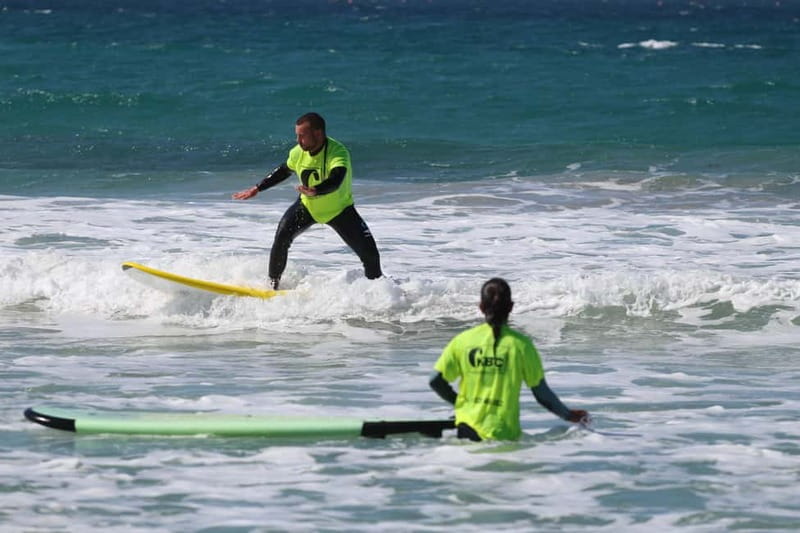
The Atlantic is waiting just beyond Tarifa’s beach. This two-hour beginner surf lesson gives you a practical first taste of the sport, with soft boards, wetsuits, a safety briefing, and an instructor who speaks several European languages. I like the strong focus on getting you upright quickly, and I like that the school has more than 10 years of experience in Tarifa. The main catch is simple: you need basic swimming skills, and the sea can force a last-minute change of plan.
You meet at the car park in front of the beach, arrive 15 minutes early, and spend the session moving from dry-land instruction to supervised practice in the water. I also like the friendly tone reported by past participants, including praise for instructor Marina, clear teaching, and helpful organization. Just remember that hotel transport, food, and drinks are not included, and the minimum booking is two students.
Key points before you book
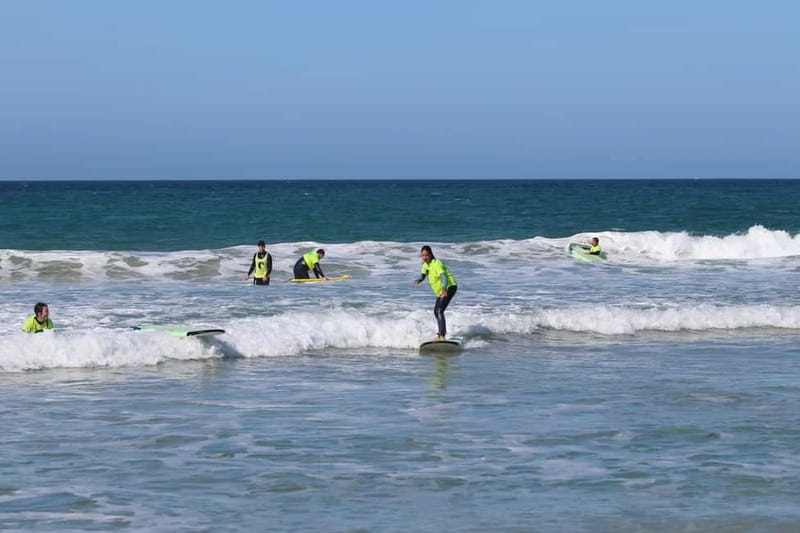
- Two hours in the water: The lesson is short enough to fit into a one-day Tarifa visit, but long enough to cover paddling, standing, speed control, and turning.
- Soft boards for first rides: The beginner-friendly boards are designed to make the early learning stage safer and less intimidating.
- Equipment is included: You get a board, wetsuit, lycra top, leash, insurance, and instruction in the quoted price.
- A multilingual teaching team: Lessons may be available in English, French, German, Italian, Polish, or Spanish.
- A weather-dependent activity: Wind and sea conditions matter, so the class can be moved or canceled if the weather is poor.
- A good first-day activity: The meeting point is by the beach, and no hotel transfer is needed, making this easy to add to a Tarifa itinerary.
Why Tarifa works for a first surf lesson
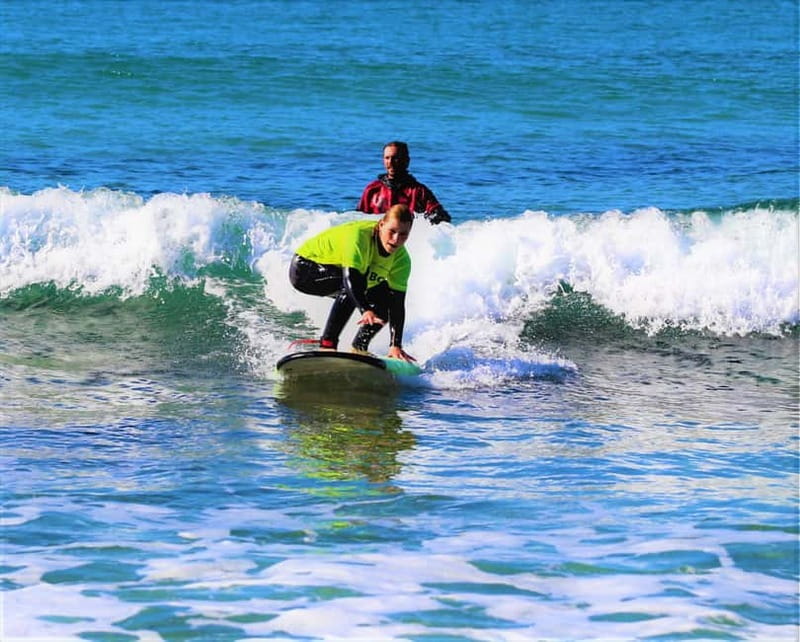
Tarifa sits at the southern edge of Europe, where the Atlantic meets the Mediterranean area around the Strait of Gibraltar. The town is famous for wind sports, but you do not need to arrive as an athlete or experienced surfer to try a board here.
This class is aimed at beginners and mixed-level participants. That matters because surfing can feel awkward at first. You are not only learning how to stand. You are also learning how to read a small wave, paddle at the right time, keep your balance, and avoid getting tangled in your leash.
The school uses soft boards for the lesson. A soft board is a sensible choice for a first session because it feels less harsh than a hard fiberglass board if you lose your balance. You still need to pay attention and follow instructions, but the equipment is made for the early learning stage.
You should also keep your expectations realistic. A two-hour class cannot turn you into a surfer. It can give you the basic movements and, if the conditions cooperate, a few short rides. That is exactly the right goal for a first attempt.
More Group Surf Lessons in Spain
- Group Surfing Lesson at Playa de las Américas, Tenerife
★ 5.0 · 1,072 reviews - Playa de las Américas: Private or Small-Group Surf Lesson
★ 4.8 · 980 reviews - Group Surf Lessons
★ 5.0 · 310 reviews
Meeting at the beach, not being collected at your hotel
The meeting point is the car park in front of the beach. You arrange your own way there, so check the location carefully before setting out. Hotel pickup and drop-off are not included.
Arriving 15 minutes early is worthwhile. You may need time to provide your full name, date of birth, and clothing sizes for the insurance paperwork and equipment. This is not glamorous beach time, but it avoids a rushed start.
The location also makes the activity easy to combine with a day in Tarifa. You do not need to spend half the morning waiting for a vehicle to collect you from a hotel. If you are already near the beach, you can go straight to the school, get changed, and begin.
The trade-off is that the experience is less convenient if you are staying outside town or traveling without easy access to the meeting point. Since no transfer is provided, transport planning is part of your job.
The first 20 minutes: safety and a dry-land warm-up
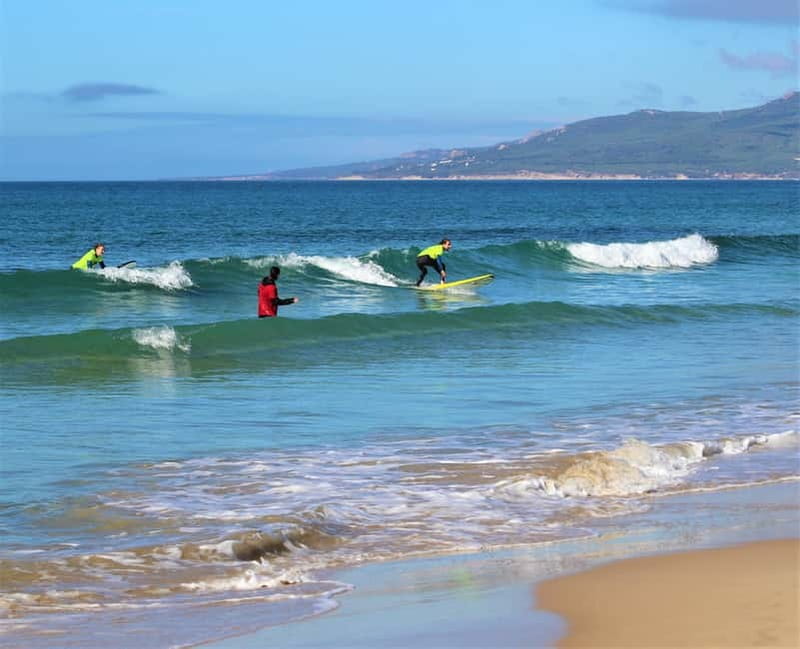
The class begins with basic theory and safety instructions. This part may sound routine, but it is one of the most useful sections for a complete beginner. You learn how the board, leash, and waves work together before you are asked to manage all three in the water.
The instructor then leads a warm-up and stretching session. Surfing uses more than your arms. You need to move quickly from lying on the board to standing, so warming up helps you understand the body position before the sea adds motion.
You will work on lying flat, paddling, and the first steps of the takeoff. The instructor explains how to spot a wave and when to begin moving. A good first lesson keeps these instructions simple, then corrects you as you try them.
I especially like this order. Beginners often want to stand immediately, but paddling and timing decide whether you catch a wave in the first place. Learning those basics on the sand gives you a clearer idea of what to do once the board starts moving.
Moving from paddling to your first standing attempt
The next stage focuses on standing posture. You practice moving from your stomach to your feet and learn how your balance changes once you are upright.
The instructor watches your position and makes corrections. Small adjustments matter here. Your feet need to be placed correctly, your knees should stay flexible, and your body needs to remain centered rather than leaning too far forward or back.
The teaching style appears to be encouraging rather than formal. The supplied feedback repeatedly praises friendly instructors, clear explanations, and a fun mood. One participant who had surfed before but had not used a large board found the experience especially rewarding. That is useful if you have tried the sport casually but still want help with proper technique.
The school is confident that even a first-timer can manage some early rides. That is an encouraging aim, but it should not be treated as a guarantee. Your result will depend on the waves, your fitness, your comfort in the water, and how quickly your body adapts.
Same place, a different way into the water:
- Tenerife: Surfing Lesson for All Levels, Photos included
★ 4.9 · 1,314 reviews - From Nerja: Guided Paddle Surf Cliffs and Maro Waterfall
★ 4.5 · 400 reviews - Playa del Inglés Maspalomas: High Quality Surf Classes
★ 4.9 · 363 reviews - Fuerteventura: Surfing Lesson in the south of Fuerteventura
★ 4.8 · 354 reviews
In the Atlantic: spotting a wave and taking off
Once the dry-land work is done, you take the board into the water with the instructor. This is where the class becomes practical.
You learn to spot a suitable wave, paddle into it, and begin the takeoff. The instructor guides you through the timing, then watches for errors and offers corrections. Early attempts may end with you sliding off, kneeling too soon, or missing the wave entirely. That is normal for a first lesson.
The soft boards help here. They offer a stable platform for practice and make the first rides feel less severe when your balance goes wrong. You still need to keep control of the board and leash, which is why the safety briefing matters.
Past feedback gives the clearest picture of the water portion. A French participant noted that everyone in the group managed to stand on the board during a first class. That does not promise the same result for every group, but it shows how the lesson is designed: the focus is on active practice, not a long lecture from the sand.
The group format has both benefits and limits. You get the energy of learning alongside other people, and the atmosphere may feel less serious than a private lesson. On the other hand, the instructor’s attention is shared. If you need repeated one-to-one correction, a private class might suit you better, though this experience is specifically offered as a group lesson.
Speed control and turning, not just standing up
Many first lessons stop once you stand for a few seconds. This one also introduces speed control and turning.
These skills help you understand what comes after the first successful ride. You learn that surfing is not simply about staying upright. You need to manage the board, adjust your posture, and begin directing your movement.
Do not expect polished turns after two hours. The value is in learning the ideas early, so you know what to practice next time. The instructor can correct your standing posture and explain how your body affects the board’s speed and direction.
This is also where the lesson becomes useful for returning participants. If you have already stood on a board but never had formal coaching, you may gain more from the posture and control work than from the first safety talk.
The class may also try to take a few photographs as a memory. This is a nice extra, but it should not be treated as a full photo service. The main product is instruction and time in the water.
What is included for the $58 price
The listed price is $58 per person, while the activity information also gives a local price of €49 per student. The dollar amount will depend on the exchange rate and booking platform, so check the final amount before paying. There must be at least two students in the class.
For that price, you receive:
- A professional instructor
- Surfboard
- Wetsuit
- Lycra top
- Board leash
- Safety briefing
- Third-party insurance
- Instruction in the water
- A chance of a few photographs
For a beach activity, that is a fair package. You do not need to buy or carry beginner surf equipment, and insurance is included. The value improves if you are visiting Tarifa for only one day, since renting equipment separately and trying to teach yourself would not give you the same structure or safety guidance.
It is less attractive if you already own equipment and have solid surf skills. In that case, you are mainly paying for group instruction and local guidance. The school’s more than 10 years in Tarifa may still appeal to you, but beginners receive the clearest value.
Food, drinks, personal spending, and hotel transport are extra. Plan around those costs rather than assuming the beach session includes refreshments.
Who will enjoy this class most
This is a good match for you if you want a first surf experience without committing to a long course. It suits couples, friends, and small groups who want an active morning or afternoon in Tarifa.
You should have basic swimming skills. That is a firm requirement, not a minor suggestion. Surfing puts you in moving water while attached to a board, so you need to feel able to manage yourself in the sea.
The class also suits people who learn best by doing. You receive theory and demonstrations, but most of the useful work happens when you paddle, attempt the takeoff, and receive a correction.
It may be less suitable if you dislike weather-based plans, need guaranteed start times, or want private coaching. Surf classes depend on sea conditions, and the activity can be rescheduled or canceled in bad weather.
The multilingual instruction is another plus. English, French, German, Italian, Polish, and Spanish may be available, which can make technical directions easier to follow. Confirm your preferred language when booking, since availability can depend on the session.
What the praise tells you about the experience
The strongest pattern in the feedback is the teaching. Participants repeatedly point to prepared, friendly, enthusiastic instructors who make the class both safe and enjoyable.
That combination matters. A strict safety lesson with no warmth can make a beginner tense. A cheerful class with poor instruction is not much better. Here, the comments point to clear explanations, practical help, and a relaxed mood.
The equipment also receives strong praise. Wetsuits, boards, and support in the water are all part of the experience, and one participant described the materials and assistance as excellent. Another praised the organization and singled out Marina after only a few instructions led to an enjoyable session.
The rating is 4.9 from eight reviews. That is a very strong result, but the sample is small. I would read it as encouraging evidence of good instruction rather than proof that every class will be perfect.
The most useful expectation is this: you are likely to get a warm welcome, clear guidance, and a serious chance to stand on the board. You are not buying a guaranteed string of perfect waves.
Weather, timing, and the small print that matters
The activity is valid for one day, with starting times based on availability. The two-hour lesson itself is the central commitment, but the actual start may depend on conditions.
Weather can lead to a rescheduled or canceled class. That is a normal part of surf planning. Ask yourself how flexible your Tarifa schedule is before booking. If you have only one narrow window before catching a train or continuing your trip, this may be a risky choice.
You can cancel up to 24 hours in advance for a full refund. The reserve-now, pay-later option also helps if you are still arranging your plans. These policies are useful, but they do not remove the basic uncertainty of an outdoor activity.
Bring the information the school requests before the class: your full name, birth date, and clothing sizes. Arrive 15 minutes early. Those simple steps help the lesson begin on time.
Should you book the Tarifa surf class?
I would book this class if you want a friendly, well-supported first try at surfing and you can accept changing weather. The combination of a two-hour lesson, soft boards, wetsuit, insurance, multilingual instruction, and beachside meeting point gives you good value at about $58, or €49 as quoted locally.
It is especially worthwhile for a one-day Tarifa visit. You can learn the basics, try for your first rides, and leave with a clear sense of whether surfing deserves more time on your trip.
I would hesitate only if you cannot swim, need private attention, already surf confidently, or have no flexibility if the sea turns rough. For most beginners, though, this is a practical way to meet Tarifa’s Atlantic coast with a board under your feet and a helpful instructor nearby.
FAQ
How long does the surf class last?
The surf lesson lasts two hours.
What does the class teach?
The class covers basic theory and safety, warm-up exercises, stretching, lying position, paddling, wave selection, takeoff, standing posture, speed control, and turning.
Is equipment included?
Yes. The price includes a surfboard, wetsuit, lycra top, board leash, and the necessary instruction equipment.
Is insurance included?
Yes. Third-party insurance is included in the activity.
Where is the meeting point?
You meet at the car park in front of the beach.
Do I need to know how to swim?
Yes. Basic swimming skills are required.
What languages may the instructor speak?
Instruction may be available in English, French, German, Italian, Polish, and Spanish.
Can the class be canceled because of weather?
Yes. The activity may be rescheduled or canceled if weather conditions are unsuitable. You can cancel up to 24 hours in advance for a full refund.
Just added around Spain
- Hire of Kayak and Paddle Surf in La llosa del cavall★ 5.0 · 2 reviews
- SURF course in Cantabria★ 5.0 · 3 reviews
- Surf course 7 days★ 3.5 · 5 reviews
- Sunset Sunrise or Full Moon Paddle Surf Experience★ 4.5 · 9 reviews
- Small Group Paddle Surf Experience in Benidorm★ 4.0 · 7 reviews
- Paddle surf guided session★ 5.0 · 4 reviews
- San Sebastián Surf House Accommodation with Meals Included★ 4.5 · 27 reviews
- Paddle Surfing in Barcelona★ 5.0 · 35 reviews
Group Surf Lessons, compared.
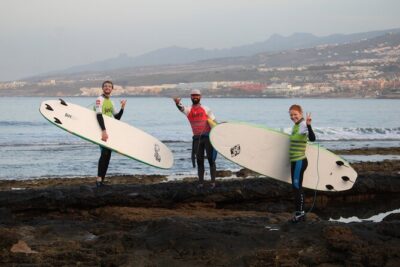
Group Surfing Lesson at Playa de las Américas, Tenerife
Read our review →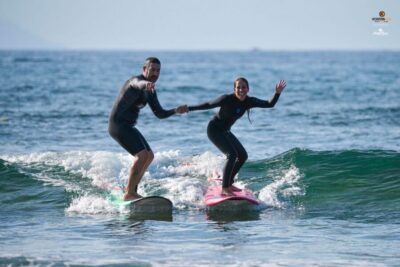
Playa de las Américas: Private or Small-Group Surf Lesson
Read our review →
Browse the lists this lesson appears in