
REVIEW · HONOLULU
Hawaii: Electric Hydrofoil Surfing Solo Lesson
Flying above the water takes patient practice. This 90-minute eFoil lesson gives you a careful way to learn, starting with a balance-board simulator before you handle the real board. I especially like the step-by-step progression from belly riding to knee riding and then standing, plus the radio helmet that keeps you in contact with the instructor.
I also like that no surfing experience is required. You learn how to use the Bluetooth remote, stop in an emergency, turn in both directions, and fall away from the board safely. The main drawback is the price: $299 per person is a serious spend for a first lesson, and the standard weight limit is 200 pounds, with an extra $49 charge for participants from 201 to 265 pounds.
The lesson includes 60 minutes on the water, all eFoil equipment, a life jacket, whistle, and land instruction. It is a good fit if you want a focused introduction rather than a quick tourist activity, but you should be comfortable in the water and ready for a physically demanding session.
Key Points Before You Book
- A balance-board simulator comes first: You practice body position and center-of-gravity control on land before handling the eFoil.
- The lesson covers three riding positions: You progress from belly riding to knee riding, then work toward standing.
- You get direct radio contact: A radio helmet lets you hear the instructor during your water practice.
- You receive 60 minutes of water time: The full activity lasts 90 minutes, with the remaining time used for fitting gear and land instruction.
- No surf background is required: Board-sport balance can help, but beginners can learn the basic progression.
- Safety is part of the lesson: You learn emergency stops, how to use the remote, and how to fall away from the board.
What the $299 Waikiki Lesson Really Includes
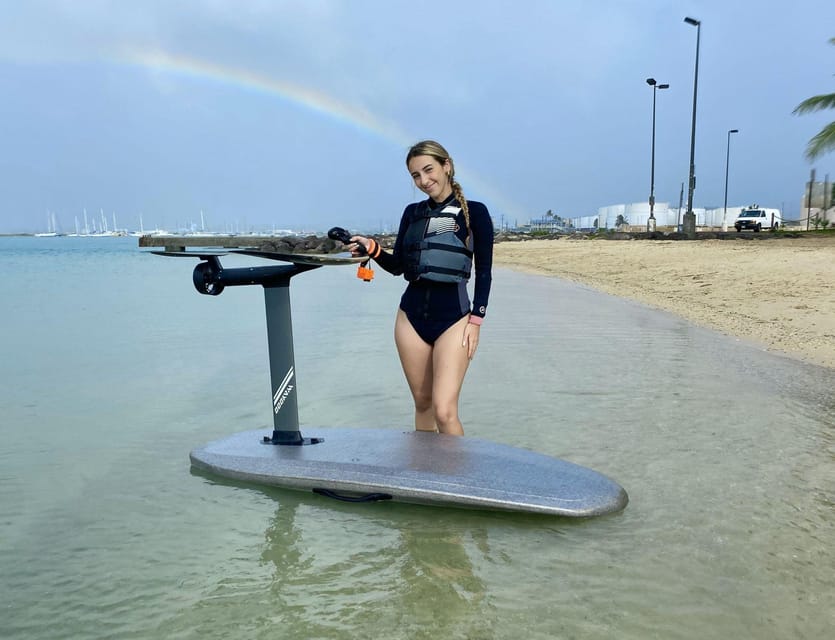
At $299, this is not a cheap add-on to a day at the beach. You are paying for instruction, equipment, safety gear, a land session, and a full hour of water practice. That matters because eFoils are not simple foam boards. You control an electric motor with a Bluetooth handheld remote while also managing your body position on a board that can rise above the water.
The equipment can be costly and unfamiliar. This lesson lets you try it without buying or transporting your own board. More important, you have an instructor guiding the first steps instead of trying to copy a video or figure out the controls alone.
The price makes the most sense if you want a real introduction and hope to progress beyond one short ride. It is less compelling if you only want a few minutes of standing on a board for a photo. The session is built around learning, not simply being towed through the water.
The format is described as a group lesson and a private group. That means you should clarify your group arrangement when booking if the size matters to you. In either case, instruction is conducted in English, and the radio helmet gives you a direct line to the instructor during the active part of the session.
More Surf Lessons in the USA:
- Maui: Two Hour Beginner Group Surf Lesson in Kihei
★ 5.0 · 950 reviews - Open Group Surfing Lesson in Waikiki, Hawaii
★ 4.5 · 582 reviews - Outrageous Surf ScHool Lesson on Lahaina Side
★ 4.5 · 547 reviews
The First 30 Minutes: Simulator, Safety, and Controls
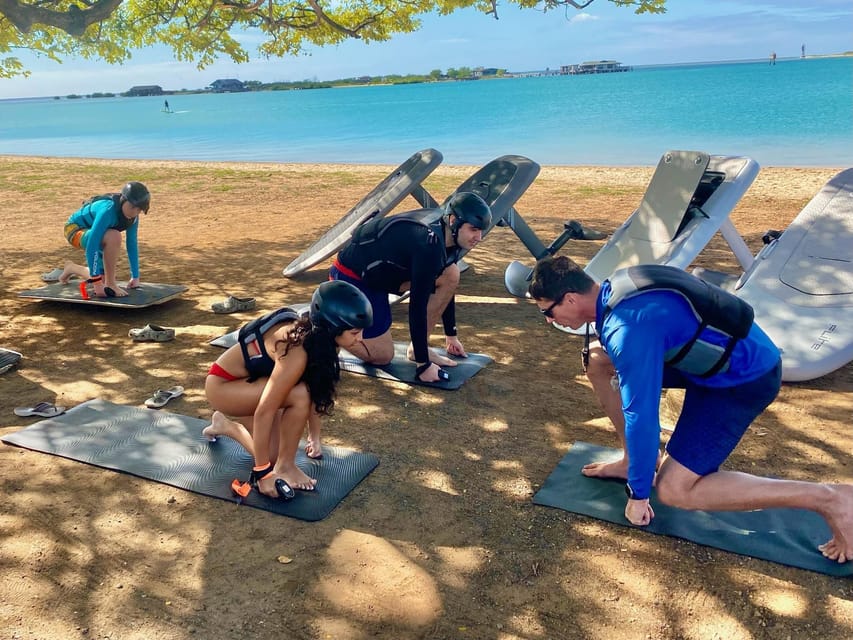
The session begins on land. You get fitted with a life jacket and whistle, then work through the balance-board eFoil simulator. This is a useful start because it lets you feel how small shifts in your body affect the board before you add moving water and an electric motor.
You practice controlling your center of gravity in three positions:
- Belly down
- Kneeling
- Standing
This order is sensible. Belly riding gives you a stable way to learn the remote and steer. Kneeling adds balance demands without requiring you to stand at once. Standing is saved for the point when you already understand how the board reacts.
The land lesson also covers the Bluetooth remote. You learn how to control the eFoil, turn the board, and perform an emergency stop. These controls are not side notes. A remote mistake can change your speed quickly, so learning its operation before entering the water makes the session calmer and safer.
You also practice how to fall away from the board. That is an important detail for beginners. The aim is not to cling to the board during every wobble. You learn to separate yourself from it in a controlled way if you lose balance.
Wear swimwear, sunscreen, and a hat. The activity provides the required eFoiling equipment, but not food, drinks, or transportation to and from the location.
Belly Riding: Learning the Board Before It Rises
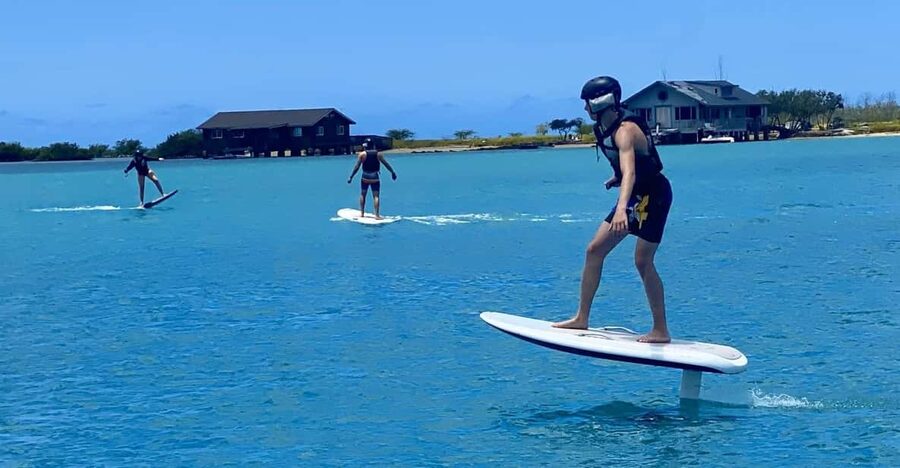
Water practice begins with belly rides. At this stage, you are not trying to fly above the water. You are getting comfortable with the board, the remote, steering, and speed control.
You practice turning the board and making emergency stops. This part may feel basic, but it gives you a usable foundation. If you know how to slow down and stop, you can focus more fully on balance later.
Belly riding also helps you learn the direction of the board without the extra challenge of standing. The eFoil has a motor and underwater foil, so it does not behave exactly like a standard surfboard. The instructor can guide you through each adjustment using the radio helmet.
This direct communication is one of the best parts of the lesson. You do not have to paddle back after every attempt to ask what went wrong. You can receive instructions while practicing, which helps keep the session moving.
Your first water time may involve plenty of resets. That is normal for a skill that combines balance, steering, acceleration, and body position. The lesson plan gives you a logical sequence instead of asking you to stand up immediately.
Kneeling and Turning in Both Directions
Once belly riding feels manageable, you move to knee riding. Here, you start making turns from a higher position and work toward the speed needed for eFoiling.
The instructor helps you practice turns in both directions. This is important because many beginners naturally favor one side. You need control on both sides to ride with confidence and to find the stance that feels natural.
You also begin accelerating to eFoiling speed. The goal is not simply to go fast. You are learning how the board changes as speed builds and how to keep your weight centered while the foil begins to create lift.
For some people, this will be the most demanding portion. Knee riding requires more balance than belly riding, while the motor adds a new control task. I would expect frequent falls and restarts, particularly if you have little board-sport experience.
The lesson allows you to take your time. Unlike a traditional surf break, you do not need to catch a wave at one exact moment. You can slowly adjust your position and work toward standing when you feel ready. That makes eFoiling approachable for beginners who might find ordinary surfing intimidating.
Same place, a different way into the water:
- Los Angeles: Surfing Lesson in Venice Beach
★ 4.8 · 442 reviews - Oahu: Beginner-Friendly Waikiki Beach Surfing Lesson
★ 4.9 · 425 reviews - Po’ipu Surf Lesson
★ 5.0 · 361 reviews - Private Hanalei Sandy Bottom Surf Lesson on Kauai
★ 5.0 · 339 reviews
Standing Up and Feeling the Foil Lift
The next step is a slow pop-up to standing. You are not expected to leap upright in one motion. Instead, you build from the position you have already practiced, moving carefully into a standing stance.
The key movement is a gradual shift of your center of gravity. As you slowly move your weight back, the board can rise out of the water into its eFoiling position. The balance-board simulator prepares you for this exact idea, so the land practice has a clear purpose.
Standing is where the activity begins to feel different from ordinary surfing. You are not waiting for a wave to carry you. The electric motor provides forward movement, while your balance and weight control determine how the board rides.
The first successful lift may last only a short time. That is still useful progress. You are learning the relationship between speed, body position, and foil height. Small corrections matter, and the instructor can guide you through them by radio.
The lesson information reports that all clients have managed to knee surf and stand during their first lesson, with most students confidently eFoiling after 30 to 60 minutes. That is encouraging, but you should treat it as a likely progression rather than a promise about how long you will remain in the air. Fitness, comfort in the water, and board-sport balance will affect your pace.
Why the Radio Helmet Helps
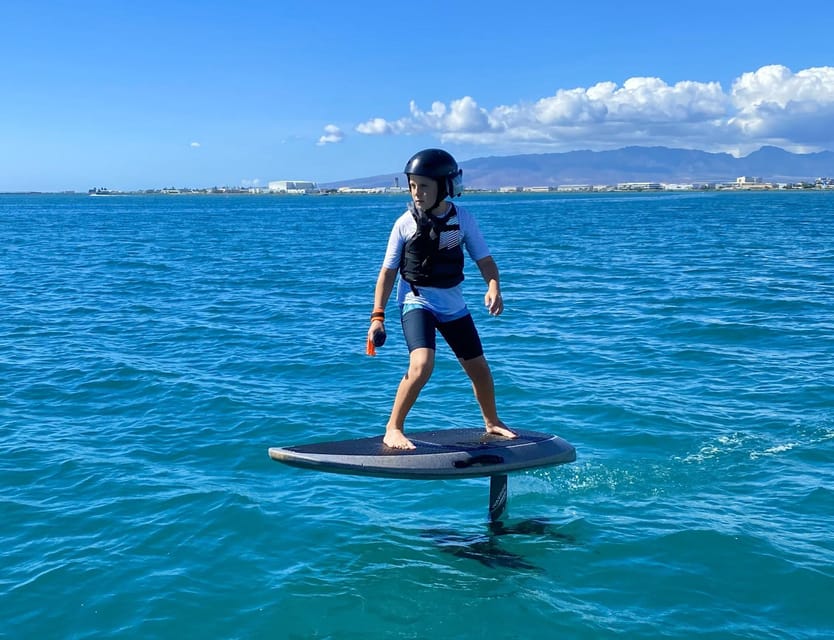
The radio helmet is more than a convenience. It gives you constant communication with the instructor while you ride, which can make a major difference during the short moments when the board begins to lift.
An instructor can tell you to adjust your weight, slow down, or prepare for a turn without waiting for you to return. That keeps the lesson active and reduces confusion.
It also helps when you are learning a movement that is difficult to explain after the fact. You may know that the board rose, but not know exactly what you did differently. Immediate guidance can help you repeat the movement instead of starting from zero.
The equipment list includes the helmet, life jacket, whistle, board, remote, and other necessary eFoiling gear. You do not need to bring your own board or safety equipment. You do need to bring suitable clothing and sun protection.
Who Will Enjoy This Most
You do not need prior surfing experience. That makes this a strong option if you have always wanted to try a board sport but have never learned to catch waves.
Board-sport balance will help you move from eSurfing to eFoiling faster. If you have experience with activities that require balance, you may feel comfortable with the transition from belly riding to kneeling and standing. Still, the lesson is designed for different skill levels, so a complete beginner can take part.
You should be comfortable in the water while wearing a life jacket. The activity is not suitable for pregnant women, people with back problems, or people with mobility impairments.
The minimum age is 10. The standard lesson has a 200-pound weight limit. Participants from 201 to 265 pounds can use an additional option for $49. Anyone outside the stated limit should confirm eligibility before booking.
This is best for someone who wants active instruction and does not mind falling into the water. It is not ideal if you are looking for a relaxed beach outing, have limited water confidence, or prefer a passive sightseeing activity.
Timing, Preparation, and Practical Details
The activity lasts 90 minutes, including the land lesson and water practice. The included water time is 60 minutes, so you should not expect the whole appointment to be spent riding.
That split is useful rather than wasteful. The simulator session covers balance, controls, riding positions, and safety. Without that preparation, your water time would likely be spent figuring out the remote and learning how to stop.
Starting times depend on availability. You should allow enough room around the lesson for changing, arriving at the location, and recovering afterward. Transportation is not included, so you must arrange your own way to and from the activity.
Food and drinks are also not included. Bring water and plan any meal or snack separately. The required personal items are simple: a hat, swimwear, and sunscreen.
Cancellation is flexible if your plans change. You can cancel up to 24 hours in advance for a full refund, and you can reserve now and pay later. Those terms are useful for a water activity, since your schedule may shift during a Hawaii trip.
The Main Drawbacks to Consider
The price is the clearest concern. At $299, this costs more than a casual beach rental, but the fee includes specialized equipment, instruction, safety gear, simulator practice, and 60 minutes on the water. The value depends on how much you want to learn.
The lesson also requires physical effort. You will spend time balancing, kneeling, standing, falling, and restarting. Even if the equipment does much of the forward work, your legs and core still have to control the board.
The 200-pound standard limit may also affect your budget. Participants between 201 and 265 pounds pay an additional $49, bringing the total to $348 before any other personal costs.
Finally, success during the session is not the same as mastering the sport. You may stand and foil during the first lesson, but regular practice would be needed to build reliable turns and longer rides. Think of this as a strong first class, not a finished skill.
Should You Book the eFoil Waikiki Lesson?
Book it if you want a serious first lesson, enjoy active water sports, and value patient instruction over a cheap one-time thrill. The simulator, radio helmet, safety training, and gradual move from belly riding to standing give beginners a clear path.
I would be more cautious if $299 feels too high for an experiment, if you are not comfortable in the water, or if you have a back or mobility problem. Check the weight rules carefully, and remember to arrange transportation and bring sun protection.
For an adventurous beginner, this is a well-structured way to try electric hydrofoil surfing without needing surf experience. The best reason to book is not simply the chance to fly above the water. It is the chance to learn the controls and body position in a setting designed to help you progress safely.
FAQ
How long does the eFoil lesson last?
The activity lasts 90 minutes, including the land lesson and water practice. It includes 60 minutes of total water time.
Do I need previous surfing experience?
No. Prior surfing experience is not required. Board-sport balance can help you progress faster from eSurfing to eFoiling.
What riding positions will I learn?
You will practice belly riding, knee riding, and standing. The lesson moves through these positions step by step.
Is safety equipment provided?
Yes. The lesson includes a life jacket, whistle, radio helmet, and all necessary eFoiling equipment. You also learn how to perform emergency stops and fall away from the board safely.
What is the weight limit?
The standard lesson has a 200-pound weight limit. Participants from 201 to 265 pounds can choose an additional option for $49.
What should I bring?
Bring a hat, swimwear, and sunscreen. Transportation, food, and drinks are not included.
Just added around the USA
- Epic Surf Lessons Dania Beach★ 5.0 · 3 reviews
- Surf Lessons Fort Lauderdale★ 5.0 · 41 reviews
- E-Foil Surfing for Beginners in Fort Lauderdale Beach★ 5.0 · 2 reviews
- Learn to surf Fort Lauderdale★ 5.0 · 6 reviews
- Learn to Surf – Destin★ 5.0 · 10 reviews
- 1-Hour Private Surf Lesson in Cocoa Beach★ 5.0 · 41 reviews
- 2 Hour Private Surf Lesson in Cocoa Beach★ 5.0 · 12 reviews
- Private Surf Lesson Solana Beach Ride the Waves Fletcher Cove 2hr★ 5.0 · 3 reviews
Honolulu Surf Lessons, compared.
Kayak, Snorkel, and Surf with Turtles in Honolulu
Read our review →


Waikiki Beginner Private Surf Lesson- Female Guide
Read our review →

Browse the lists this lesson appears in