
REVIEW · BIG ISLAND
Go Surf Hawai’i (Kona Coast)
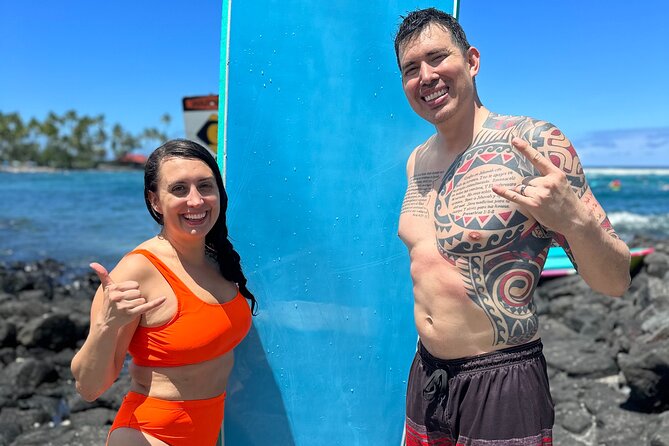
Catch your first wave in historic Kona. Go Surf Hawai’i offers a small, beginner-friendly lesson near Kailua-Kona, with soft-top boards, rash guards, and patient coaching included. I like the maximum four-person group, which gives you more attempts and more help in the water. I also like the local advice on surf spots, food, and beaches beyond the usual visitor route.
The main thing to consider is the ocean itself. Conditions change, and one scheduled session was moved because the waves were too poor. You should also have a moderate level of fitness and feel comfortable in the water. The lesson lasts about 90 minutes, and the most personalized option is a private lesson, required for children under nine.
Key Points Before You Book
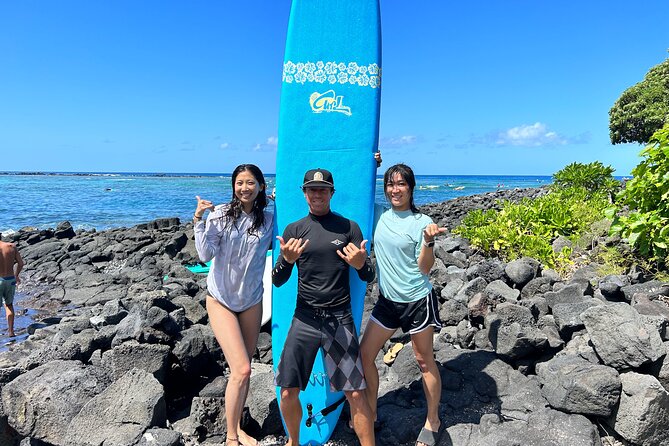
- Small groups make a real difference: The maximum is four people, so the coach can give individual tips instead of shouting instructions from shore.
- The lesson starts on land: You learn paddling, the pop-up, and balance before heading into the water.
- Jared, Jace, Rory, and Renee have all coached here: Feedback repeatedly highlights patience, clear instruction, and calm support.
- You receive the main gear: A soft-top board and rash guard are provided, with photography sometimes available at an extra arrangement.
- The goal is a first ride, not a surf contest: Mellow breaks help beginners get attempts without needing advanced skills.
- The local advice continues after the lesson: You can ask about where to surf, eat, and explore during the rest of your Big Island stay.
Why This Kona Surf Lesson Works for Beginners
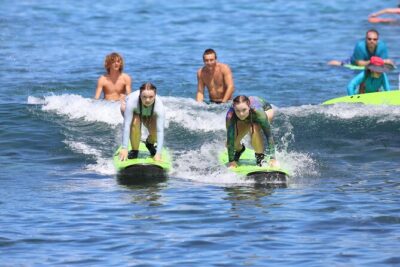
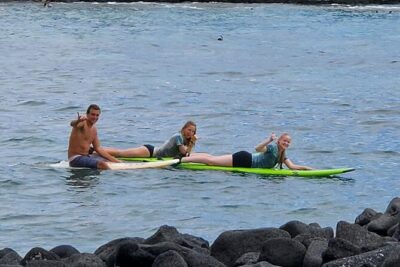
Surf lessons can go wrong when the group is too large. A coach may explain the pop-up once, then spend most of the session helping someone else. Here, the four-person limit gives you a better shot at personal instruction and repeated attempts.
That matters most if you are nervous. Jared has been praised for a gentle approach with first-timers, including adults who were worried about getting into the ocean. Jace has also earned praise for adjusting instruction to different ability levels within the same family.
You do not need to arrive as an athlete. One older beginner described feeling successful despite not being in the best physical condition. Another family had a more experienced husband and a timid first-time wife, and the instruction was adjusted so both could have a worthwhile session.
Still, surfing is physical. You will paddle, push up, balance, and get back on the board many times. The stated requirement is a moderate fitness level, and you should be comfortable swimming and handling yourself in the ocean. If you tire easily, tell the coach early so the lesson can be paced sensibly.
More Surf Lessons in the USA:
- Maui: Two Hour Beginner Group Surf Lesson in Kihei
★ 5.0 · 950 reviews - Open Group Surfing Lesson in Waikiki, Hawaii
★ 4.5 · 582 reviews - Outrageous Surf ScHool Lesson on Lahaina Side
★ 4.5 · 547 reviews
Meeting at 78-6680 Ali‘i Drive
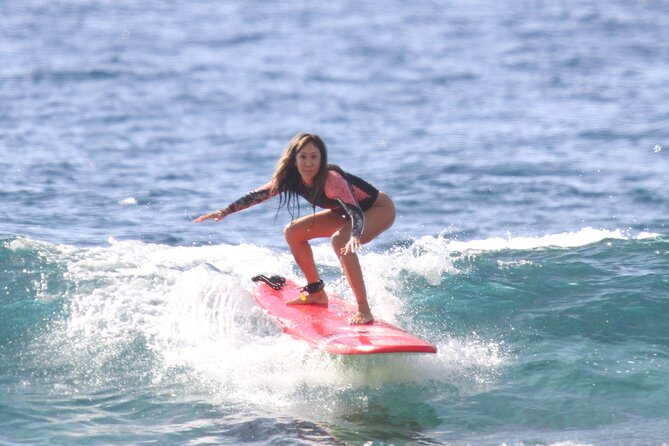
The lesson begins at 78-6680 Ali‘i Dr. in Kailua-Kona and returns to the same meeting point. Directions have been described as clear, and the location is near public transportation.
Arrive ready to focus on the lesson rather than hunt for equipment. The company provides a soft-top surfboard and a rash guard. A soft-top board is a good choice for new surfers because it is forgiving and easier to manage than a hard board. The rash guard also helps protect your skin from sun and board friction.
Bring the usual beach basics, such as sun protection and something dry to wear afterward. The provided rash guard is useful, but you should not assume it replaces all sun protection. A long-sleeved option is worth requesting or wearing if the day is bright.
The meeting point is also where the activity ends, which keeps the logistics simple. You do not need to arrange a separate pickup or figure out how to return rented equipment across town.
Dry-Land Coaching Before the Water
The first part of the session covers the mechanics on shore. Your coach walks you through how to paddle, where to place your hands, how to pop up, and how to find your balance.
This may sound basic, but it is one of the most useful parts of the lesson. A rushed beginner often tries to stand before the board is moving properly, then falls before getting a feel for the wave. Practicing the sequence first gives you a plan to repeat in the water.
Jace has been praised for correcting form and explaining how to spot waves and turn. Another lesson was described as technical without being confusing. That is the right balance for a first session: enough detail to improve your chances, but not so much that you are thinking about ten body positions at once.
Pay attention to the turning instructions. One beginner had trouble steering in the desired direction and wanted a little more explanation about using arms and legs. That is a useful warning. Standing is only the first milestone. Turning, controlling the board, and paddling back are separate skills.
The Mellow Break and Your First Waves
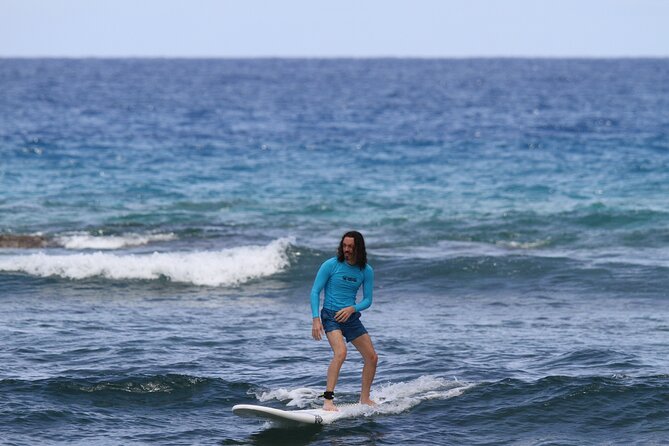
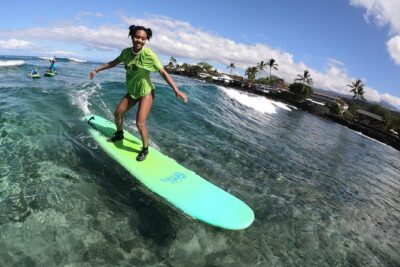
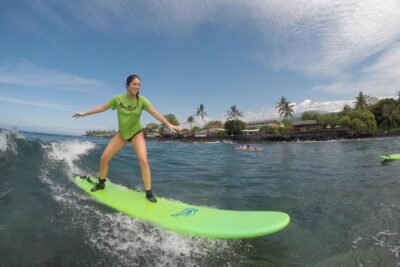
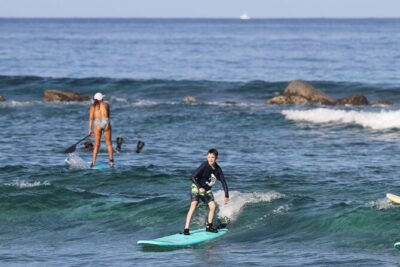
After the shore instruction, you head to a beginner-friendly break. The coach helps position you for incoming waves and gives guidance as you paddle and try to stand.
The aim is not to send you into a powerful break and hope for the best. The focus is on manageable waves and repeated attempts. Families with children as young as 10 and 13 were able to stand and ride, while adults with little or no surf experience also caught waves.
Success is not guaranteed. Surf depends on tide, wind, wave shape, and crowding. One family arrived on a very flat day and still got up successfully, but another booking had to be moved because there were no suitable waves. That flexibility is a good sign. A responsible surf school should not force a lesson into poor conditions simply to keep the calendar unchanged.
A crowded day can add another challenge. One family took the lesson during the Christmas period, when the break was busy and the tide was strong. The group still had many chances, but conditions were less relaxed than on a quiet morning.
If you have a choice, ask about the best available time when booking. The supplied information does not promise a specific tide or wave schedule, so treat every session as conditions-dependent.
Same place, a different way into the water:
- Los Angeles: Surfing Lesson in Venice Beach
★ 4.8 · 442 reviews - Oahu: Beginner-Friendly Waikiki Beach Surfing Lesson
★ 4.9 · 425 reviews - Po’ipu Surf Lesson
★ 5.0 · 361 reviews - Private Hanalei Sandy Bottom Surf Lesson on Kauai
★ 5.0 · 339 reviews
What the Coaches Do Well
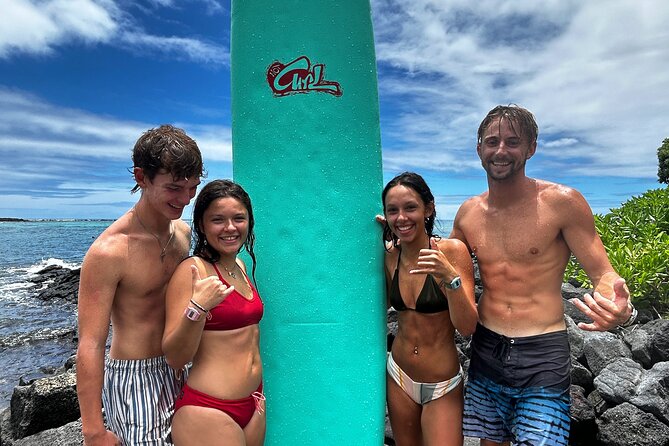
The strongest theme here is the coaching style. Jared is repeatedly described as patient, kind, encouraging, and safety-minded. Jace receives similar praise for clear communication, careful form correction, and area knowledge. Rory has helped both adults and children, and Renee has also been praised for patient teaching.
That range matters when a family has mixed confidence. A 12-year-old may be ready to charge ahead while a parent is still deciding if standing on a board is a good idea. The coach can work with both levels inside the same small group.
The instruction also seems to go beyond pushing people into waves. You receive advice on technique, wave spotting, and what to practice next. That gives the session more lasting value than simply being pushed into a few rides.
The personal care can be unusually thoughtful. In one case, Jared helped a student who had low blood sugar before the lesson, then stayed to help locate lost glasses afterward. That is not something you should expect as part of a standard surf lesson, but it shows the kind of attentive service the company tries to provide.
At the end, some sessions have included fresh coconut juice. It is a small touch, but a welcome one after physical work in the sun.
Gear, Photos, and Session Length
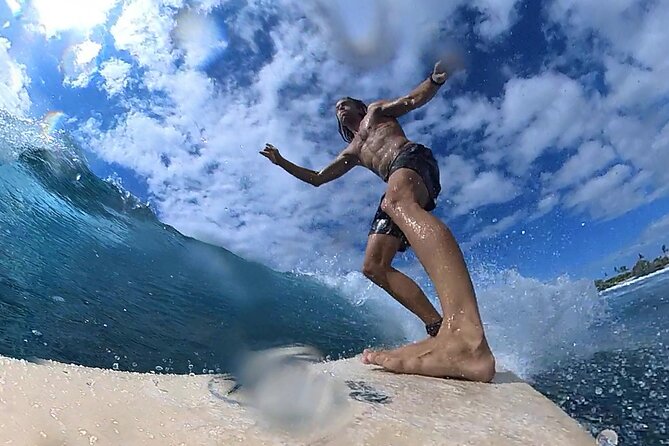
The listed duration is about 1 hour and 30 minutes. That includes preparation, dry-land teaching, and time in the water. Some families reported spending roughly 75 to 90 minutes on the water, but you should not treat that as a guaranteed water-only period.
The board and rash guard are included, which improves the value for a one-time lesson. You do not need to buy or transport equipment for the rest of your vacation. If you decide to keep surfing, the coach can offer advice about equipment rental and local beaches.
A freelance photographer may be available to capture your session. Availability varies, so request it in advance and do not assume photos are included. If pictures matter to you, ask about the arrangement before the lesson begins. Otherwise, bring a waterproof camera only if you can secure it safely and are comfortable managing it in the ocean.
The experience is offered in English. The small group and direct coaching make it easier to ask questions than in a large class.
The Value of a Four-Person Group
No price is provided here, so I cannot judge the exact dollar amount. I can still explain where the value comes from.
A small group is often worth paying a little more for in a surf lesson. You get more chances to receive feedback, fewer long waits, and a better chance to have the coach notice why you are falling. The value is especially clear when several family members have different goals.
The group limit also makes the lesson feel less like a conveyor belt. You can ask about board rentals, beaches, restaurants, and where to practice next. The local tips may save you from spending the rest of your trip at a crowded or unsuitable break.
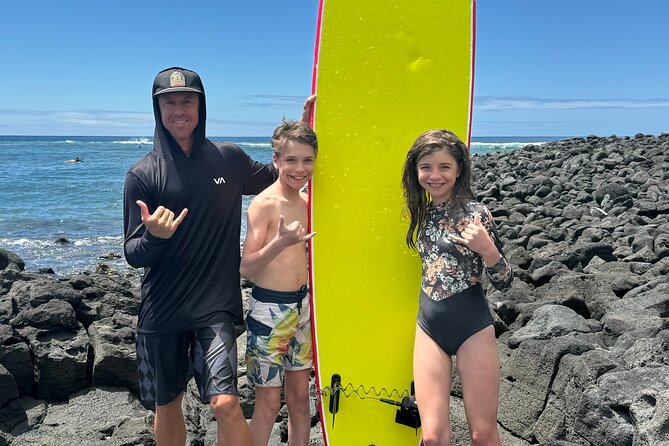
Private lessons are required for keiki under nine. If you are booking for younger children, confirm the private format and any age-specific arrangements before paying. Families with older children can use the small group format, but young surfers still need to be comfortable in the water and able to follow instructions.
Local Advice Beyond the Lesson
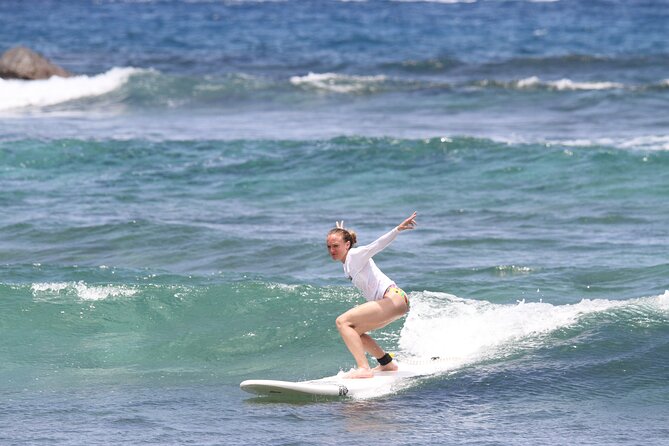
One of the best extras is the chance to ask about the rest of your Kona stay. The coaches can point you toward places to surf, eat, and explore outside the standard tourist circuit.
That advice is useful because surf conditions vary. A beach that works well one day may not be right the next. You can ask what fits your ability, where to rent equipment, and what kind of conditions to avoid.
The lesson also gives you a better sense of the coast. The area is often described as an important place in the story of surfing, and learning here adds a little context to the activity. You are not just checking off a beach activity. You are trying a sport in a place with a strong local connection to it.
Keep expectations sensible. This is not a full surf-training course, and 90 minutes will not make you an independent surfer in every condition. It can give you the basic movements, confidence, and vocabulary to continue safely.
Weather, Cancellations, and Communication
The experience requires good weather. If poor conditions cause a cancellation, you are offered another date or a full refund.
You can cancel for a full refund up to 24 hours before the start time. Changes or cancellations inside that window are not accepted, and the local start time controls the cutoff.
There was one serious communication problem reported after a third-party booking. The group waited for an instructor who did not arrive, and the operator attributed the problem to messages not passing properly between booking companies. The operator said refunds and rescheduling were arranged.
I would confirm the meeting time and location directly after booking, especially if you use a third-party platform. That simple step can reduce the risk of a bad start. The operator says direct bookings avoid this particular communication issue, but the practical advice is the same: keep the contact details handy and verify the plan.
Who Should Book Go Surf Hawai’i
I would choose this lesson for:
- First-time surfers who want patient guidance
- Families with children old enough to follow ocean instructions
- Couples with different confidence or experience levels
- Adults who are nervous but physically able to try
- Small groups that want coaching instead of a large class
- People who want local advice for the rest of their Kona stay
I would think twice if you need guaranteed large waves, a long surf session, or advanced coaching. Conditions may be flat, crowded, or less predictable than you hoped. You should also reconsider if you are not comfortable swimming or have difficulty with moderate physical activity.
Should You Book This Surf Lesson?
Go Surf Hawai’i is a strong pick for a first surf lesson on the Kona Coast. The four-person limit, supplied equipment, adaptable coaches, and mellow break give beginners a fair chance to stand up and ride.
I especially like it for families. The coaches have worked well with nervous adults, teenagers, and children, while still offering useful feedback to more confident surfers. Book it if your goal is to learn the basics, catch a few waves, and leave with a better idea of where to continue.
Confirm conditions and meeting details before you go. If the ocean cooperates, this could be one of the most memorable active outings of your Big Island stay. If the waves are poor, appreciate the chance to reschedule rather than forcing a frustrating lesson.
FAQ
How long does the Go Surf Hawai’i lesson last?
The experience lasts approximately 1 hour and 30 minutes. This includes preparation, dry-land instruction, and surfing time.
Where does the lesson start?
It starts at 78-6680 Ali‘i Dr., Kailua-Kona, Hawaii 96740. The activity ends back at the same meeting point.
Is surf equipment provided?
Yes. A soft-top surfboard and rash guard are provided.
Is the lesson suitable for beginners?
Yes. The lesson uses beginner-friendly surf breaks and covers paddling, the pop-up, and balance step by step.
How many people can join the lesson?
The activity has a maximum of four participants, allowing for more personal instruction.
Are children under nine allowed to join?
Children under nine must take a private lesson. Confirm the private format when booking.
Are photographs included?
Photography may be available through a freelance photographer, but availability varies. Let the company know if you would like photos.
What is the cancellation policy?
You can cancel up to 24 hours before the start time for a full refund. If poor weather causes the company to cancel, you are offered another date or a full refund.
Just added around the USA
- Epic Surf Lessons Dania Beach★ 5.0 · 3 reviews
- Surf Lessons Fort Lauderdale★ 5.0 · 41 reviews
- E-Foil Surfing for Beginners in Fort Lauderdale Beach★ 5.0 · 2 reviews
- Learn to surf Fort Lauderdale★ 5.0 · 6 reviews
- Learn to Surf – Destin★ 5.0 · 10 reviews
- 1-Hour Private Surf Lesson in Cocoa Beach★ 5.0 · 41 reviews
- 2 Hour Private Surf Lesson in Cocoa Beach★ 5.0 · 12 reviews
- Private Surf Lesson Solana Beach Ride the Waves Fletcher Cove 2hr★ 5.0 · 3 reviews
Big Island Surf Lessons, compared.
Premium group surf lessons- Kona’s Best Surf Lessons
Read our review →
Browse the lists this lesson appears in