
REVIEW · TENERIFE
Tenerife: Surfing Lesson for Kids in Las Americas
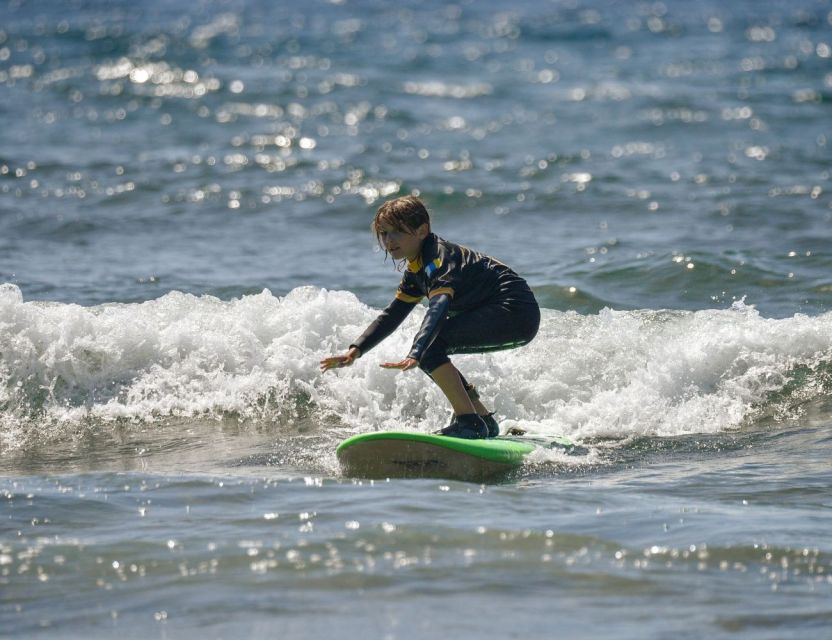
First waves make lasting memories. This two-hour lesson at Playa de Las Americas gives children a careful introduction to surfing, with expert coaching, a softboard, wetsuit, reef boots, and accident insurance included. I especially like the private format, since instructors can adjust the lesson to each child, and the strong focus on safety. I also like the chance to surf with views toward Teide volcano, a memorable backdrop for a first lesson.
The main point to consider is that every student must know how to swim. Surfing times can also change with the weather and sea conditions, and a lesson may be postponed or canceled if conditions are not suitable. That flexibility is sensible, but it means you should avoid booking this as your only fixed activity in Tenerife.
Key points at a glance
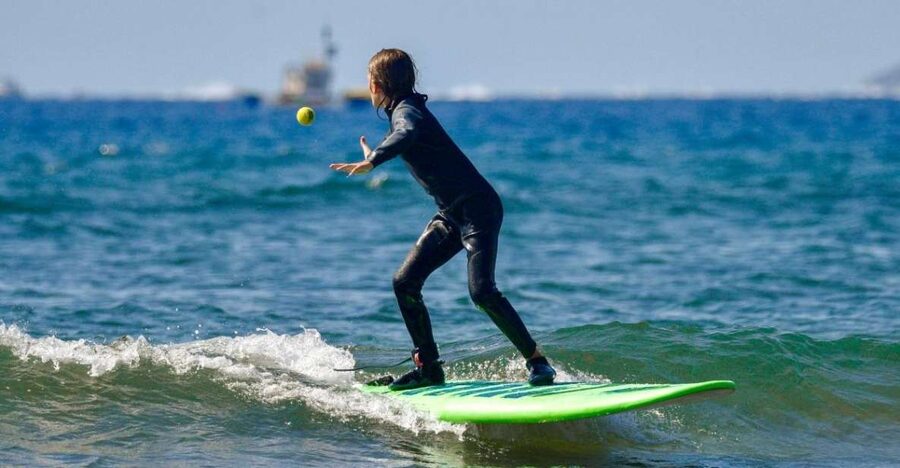
- Private coaching for children: The lesson is arranged for a private group, allowing instruction to match the child’s ability.
- A full two hours on the schedule: That gives young beginners time to learn paddling, practice basic technique, and work toward standing on a wave.
- Safety comes first: Children must know how to swim, and accident insurance is included.
- Equipment is provided: The price covers reef boots, a wetsuit, and a softboard.
- A strong first-lesson setting: Playa de Las Americas offers ocean views and a clear view toward Teide volcano.
- A guide praised by name: Raffa was specifically praised for being kind, capable, and good with children.
What this Las Americas surf lesson is really like
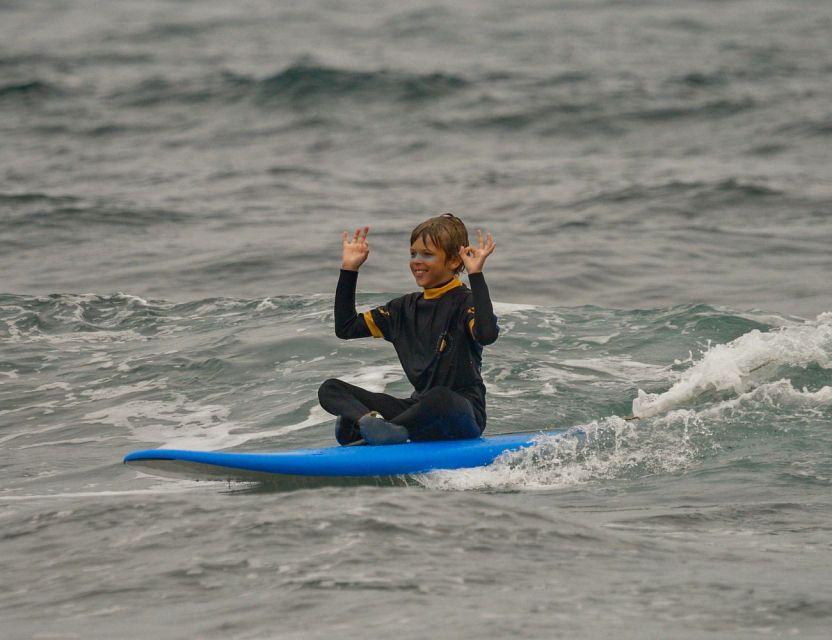
This is designed as a first step into surfing, not as a hard-driving training session for young experts. The instructor begins with basic skills and builds from there, with the stated aim of helping children paddle, understand surfing fundamentals, and stand on their first wave.
That makes the lesson a good match for a child who is curious about the ocean but has never handled a surfboard. You should expect instruction to be adjusted to the child’s ability, rather than a one-size-fits-all class. The private setup matters here. A child who needs extra explanation can get it, while a confident beginner may move ahead more quickly.
The experience lasts two hours. That is long enough to feel like a real activity, rather than a quick tryout, but short enough for most children to manage without the session becoming tiring. Surfing asks for steady effort, especially when paddling and getting back into position after a wave. The length gives the instructor room to explain, demonstrate, correct, and let the child try again.
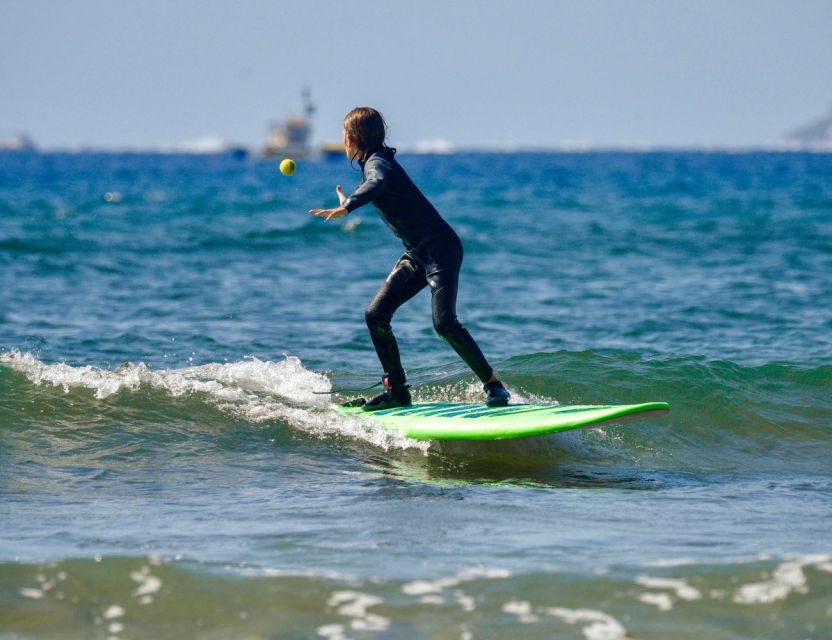
You should think of the lesson as a mix of instruction and practice. The goal is not simply to put a child on a board for a photograph. The lesson covers paddling techniques, basic surfing skills, and the mechanics of standing up. Those building blocks are useful even if the first session produces only a few seconds upright.
More Family and Kids Surf Lessons in Tenerife:
- Family, Private & Group Surfing Lessons, Waikiki Courtesy Shuttle
★ 5.0 · 216 reviews - Family, Private & Group Standup Paddle Lessons in Waikiki
★ 5.0 · 143 reviews - Family, Private & Group Bodyboard Lessons in Waikiki
★ 5.0 · 106 reviews
Playa de Las Americas and the Teide backdrop
The lesson takes place at Playa de Las Americas, one of Tenerife’s best-known coastal areas. The setting adds something important for families: you are not only paying for a technical lesson, but also for a memorable holiday activity in a famous part of the island.
The view toward Mount Teide gives the session a distinctive Tenerife feel. Children may remember the mountain and the sea together long after they forget the details of foot placement. Parents also get a pleasant setting while watching the lesson and waiting nearby.
The surf location is described as being under one of the best waves in Europe. Treat that as promotional language rather than a guarantee of perfect waves every day. Sea conditions change, and the operator makes clear that timing depends on weather and the ocean. The same conditions that create good surfing can also make a lesson unsuitable, so the schedule may shift.
This is one reason I would avoid placing the lesson on the final morning of a short holiday. Give yourself some spare time in Tenerife in case the session needs to move. The cancellation and weather policy is practical, but weather flexibility works best when your itinerary has room to breathe.
A step-by-step look at the two hours
Getting to the surf school
The meeting point is reached by taking a large staircase next to a BBVA bank. Go straight, then turn right. The local is at the end of the corridor.
That description is useful, but I would allow extra time to find the entrance. A child arriving for a first surf lesson may already be excited, and rushing around looking for the correct staircase is not the best start. Bring the booking details with you and check the meeting instructions before leaving your accommodation.
The available information does not state a hotel pickup service, so you should plan to reach the meeting point yourself. It also does not list a transfer from another resort. If you are staying outside Las Americas, check your own transport plans before booking.
More Surf Lessons in Tenerife:
- Tenerife: Surfing Lesson for All Levels, Photos included
★ 4.9 · 1,314 reviews - Group Surfing Lesson at Playa de las Américas, Tenerife
★ 5.0 · 1,072 reviews - Playa de las Américas: Private or Small-Group Surf Lesson
★ 4.8 · 980 reviews - Group Surf Lessons
★ 5.0 · 310 reviews
Getting ready with the right equipment
The lesson includes all the core equipment: reef boots, a wetsuit, and a softboard. That keeps the experience simple for families. You do not need to pack or rent a board separately, and the softboard is a sensible choice for beginners because it is designed for introductory practice.
You need to bring swimwear and flip-flops. Wear the swimwear under the wetsuit, and use the flip-flops for walking to and from the water. The provided reef boots are important because they help protect feet while children work around the shore and board.
Accident insurance is also included. That does not remove the need to follow instructions, but it is a useful part of the package for parents comparing activities. Safety is not presented as an afterthought here. It is part of the lesson’s basic structure.
Learning the first surfing skills
The instructor works through paddling and surfing basics before the child attempts to stand. This order matters. A child needs to understand how to lie on the board, move it through the water, and respond to a wave before trying to rise.
The lesson is meant to be step by step. That can make a big difference for children, who may become frustrated if they are pushed straight into standing without understanding the board. An instructor who gives clear, small tasks can turn an unfamiliar activity into something manageable.
The experience is taught in Spanish and English. For families who do not speak Spanish, English instruction is available. Clear communication is especially important in a water activity, so it is worth confirming that the child is comfortable following instructions in the selected language.
Working toward the first wave
The central moment is catching a wave and standing up. Some children may reach that goal quickly. Others may spend more time learning how to balance, paddle, and position themselves. The private format gives the instructor room to work at the child’s pace.
The stated aim is to help children catch their first waves with confidence. You should still keep expectations realistic. The ocean decides how many suitable waves appear, and the lesson time can be affected by weather and sea conditions. A successful session may mean standing up, but it may also mean learning how to handle the board safely and feeling ready to try again.
That is part of the value of a first lesson. Surfing is not learned in a single attempt. A calm introduction, a safe experience, and a child who wants another session can be a better result than forcing a dramatic first ride.
Why the private format matters for children
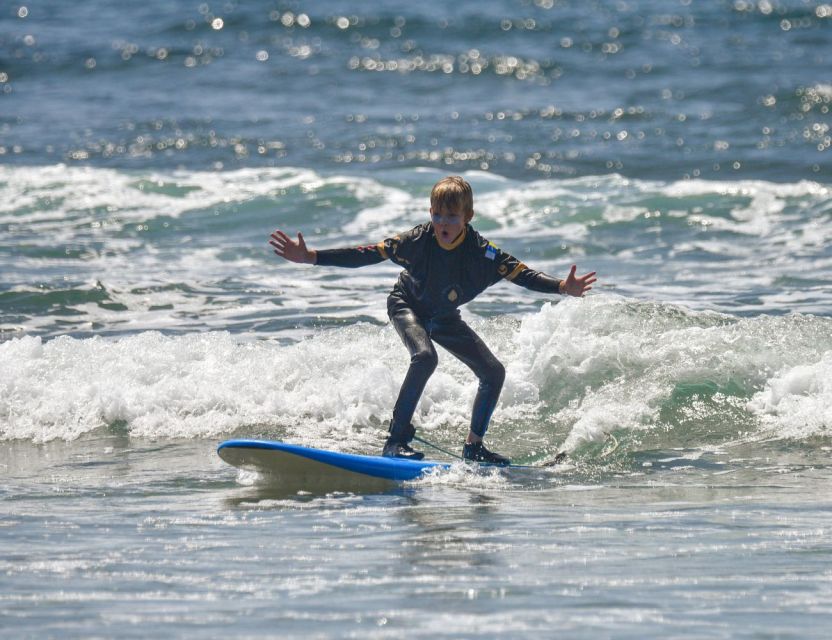
A private group is one of the strongest reasons to choose this activity over a standard group class. Children learn at different speeds. One child may need help with balance, while another may be ready for more practice catching waves.
The description emphasizes personalized attention and instruction matched to ability. For parents, that can make the lesson feel more useful than a large class where an instructor must divide attention among many students. It may also help a nervous child settle in, since the teaching can focus more closely on individual concerns.
The wording combines private lesson and private group. That means you should clarify the exact setup if several children from your family are attending. The experience is presented as private, but the information does not specify the maximum number of children in that private group.
The private structure is also helpful for older children who want to learn seriously. A verified booking for a 14-year-old boy received praise for high safety standards, kind staff, and clear instruction in surfing basics. The boy enjoyed the lesson enough that a group lesson was planned a few days later. That is a useful sign that the session can work for teenagers, not only small children.
Safety, swimming, and weather limits
The most important requirement is simple: every student must know how to swim. The activity is not suitable for non-swimmers. Do not treat this as a casual water play session where an instructor can compensate for a child’s lack of swimming ability.
The instructor leads the lesson with safety in mind, and accident insurance is included. Still, your child needs enough swimming ability to follow directions in the sea and remain comfortable in the water. If you are unsure, this is the first point to settle before paying.
Weather controls the timetable. The start time depends on conditions, and the lesson can be postponed or canceled if the sea or weather is not suitable. This may be disappointing, especially for a child who has been looking forward to surfing, but it is the right approach for a beginner’s activity.
You can cancel up to 24 hours in advance for a full refund. The reserve-now-and-pay-later option also gives you more flexibility while finalizing your holiday plans. These policies are useful, but they do not guarantee that the weather will cooperate on your preferred day.
Is $93 per person good value?
The price is $93 per person for two hours. That is not a cheap beach activity, especially if several children are joining. The value depends on what you would otherwise need to arrange.
The price includes the main equipment, including reef boots, a wetsuit, and a softboard. It also includes accident insurance and private instruction. Those inclusions make the price easier to justify than a simple board rental, because you are paying for coaching, equipment, and supervision rather than only access to gear.
The private format is the biggest factor in the value calculation. If your child benefits from close attention, or if you want to avoid a large class, the higher price may make sense. It is also a reasonable choice for a child who has already tried surfing and wants focused help with technique.
The price does not include photographs. If you want pictures of the lesson, you will need to ask about that separately and budget for any additional cost. Do not assume that a photo package comes with the booking.
For one child who is genuinely interested in surfing, I think the price can be fair. For a family booking several children, compare the cost carefully with group options. The private attention is valuable, but not every child needs it to enjoy a first try.
What parents should bring and plan for
Keep the packing list easy:
- Swimwear
- Flip-flops
- Booking details
- A little extra time for finding the meeting point
The operator supplies the reef boots, wetsuit, and softboard. You do not need to bring a surfboard. The supplied gear also means you can book this as a holiday activity without building an entire beach kit around it.
Plan around the weather. Since the session can move or be canceled, avoid arranging an important dinner, airport transfer, or tightly timed excursion immediately afterward. The lesson itself is two hours, but conditions may affect the start time.
The meeting directions use a BBVA bank and a large staircase as landmarks. Those are helpful reference points, but you should still read the instructions before setting out. Arriving early is particularly wise with younger children who need time to change and get comfortable.
The instruction quality and child-friendly approach
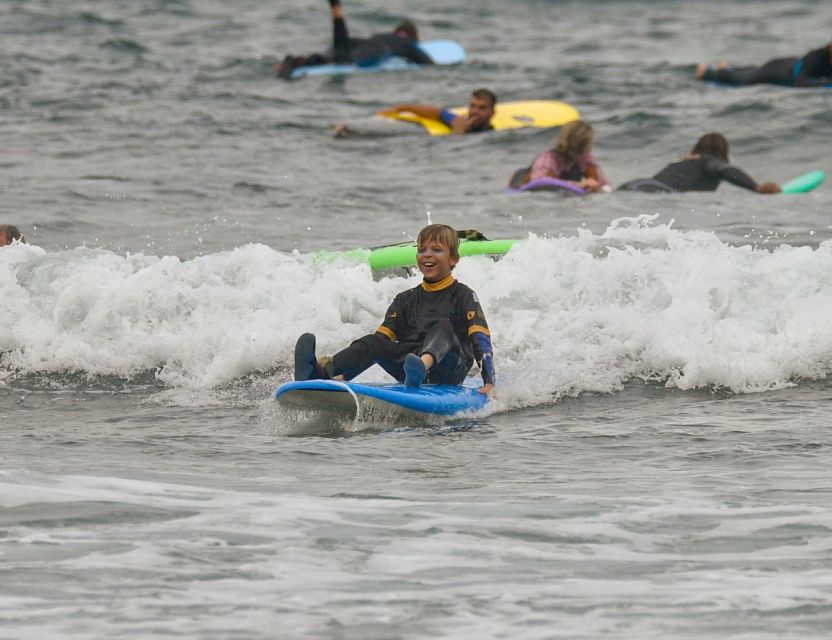
The strongest praise connected with this experience concerns the instructors. Raffa was specifically described as kind, capable, and good with children. Another booking for a 14-year-old praised the staff’s kindness and high level of safety.
Those details matter more than flashy promises. A child’s first surf lesson can go badly if the instructor is impatient or unclear. A calm teacher who explains each move and pays attention to safety can make the difference between a child wanting to try again and a child deciding surfing is not for them.
The available information names Raffa, but it does not promise that every session will be taught by Raffa. If having a particular instructor matters to you, ask when booking. The important point is that the experience is designed around guided learning, not simply handing a child a board.
The Spanish and English language options also make this easier for international families. You should select the language your child follows most comfortably, especially because water safety instructions need to be understood quickly.
Who should book this experience?
I would recommend it for:
- Children who can swim and want to try surfing
- Families seeking a private or closely tailored lesson
- First-time surfers who need calm, clear instruction
- Teenagers who want to learn basic technique
- Parents looking for a memorable two-hour activity in Las Americas
- Families who can keep their schedule flexible around weather
I would not choose it for a non-swimmer. I would also think twice if your child dislikes changing plans, since the lesson time can be adjusted and the session may be postponed or canceled.
This is best for a child who is curious and willing to practice. Surfing is physical, and the first attempts may involve more paddling and balancing than standing tall on a wave. Set the expectation that learning is the goal, not a guaranteed perfect ride.
Should you book the kids surfing lesson?
Book it if your child can swim, wants to try surfing, and would benefit from private attention. The combination of a two-hour lesson, supplied equipment, accident insurance, English or Spanish instruction, and a child-friendly teaching approach gives this experience real substance.
The best reasons to choose it are the private format, the safety focus, and the chance to learn in Playa de Las Americas with Teide in view. The main cautions are the $93 price, the lack of included photographs, and the fact that weather controls the schedule.
If your child is excited by the idea of catching a first wave, this is a strong holiday activity. Keep your plans flexible, arrive prepared, and make sure swimming ability is not in doubt. A first lesson that feels safe and enjoyable is the kind of start that can turn a beach curiosity into a lasting interest.
FAQ
How long is the surfing lesson?
The lesson lasts two hours.
Where does the lesson take place?
It takes place at Playa de Las Americas in Tenerife, in the Canary Islands, Spain.
What equipment is included?
The lesson includes reef boots, a wetsuit, and a softboard.
Do children need to know how to swim?
Yes. Every student must know how to swim, and the activity is not suitable for non-swimmers.
What should children bring?
They should bring swimwear and flip-flops.
Is the lesson private?
The activity is described as a private surfing lesson for a private group, with instruction tailored to the participants’ abilities.
What languages are available?
Instruction is available in Spanish and English.
Is accident insurance included?
Yes. Accident insurance is included in the price.
Are photos included?
No. Photos from the lesson are not included.
Can the lesson time change because of weather?
Yes. The lesson time depends on weather and sea conditions, and the session can be postponed or canceled if conditions are unsuitable.
Just added around Tenerife
- Tenerife: Surfboard and Surf equipment Rental★ 5.0 · 3 reviews
- Tenerife: Private Surf Lesson catch your wave★ 4.3 · 4 reviews
- Tenerife – Las Américas: Surf Lesson (Small Groups,All Gear)★ 5.0 · 6 reviews
- Tenerife: Group Surf Lesson catch your wave★ 4.8 · 23 reviews
- Tenerife : clases de surf para principiantes y intermedios★ 4.9 · 35 reviews
- Small Group Surf Lesson in Playa de las Américas★ 5.0 · 5 reviews
- Playa de Las Americas: Surfing Lesson with Photo Analysis★ 4.9 · 14 reviews
- Playa de Las Américas: Premium Surf Equipment for Rent★ 4.9 · 13 reviews
Family and Kids Surf Lessons, compared.
Family, Private & Group Surfing Lessons, Waikiki Courtesy Shuttle
Read our review →
Family, Private & Group Standup Paddle Lessons in Waikiki
Read our review →
Family, Private & Group Bodyboard Lessons in Waikiki
Read our review →Family, Private & Group Bodyboard Lessons in Waikiki
Read our review →
Kids Surfing Lesson in Waikiki Beach (up to 12)
Read our review →
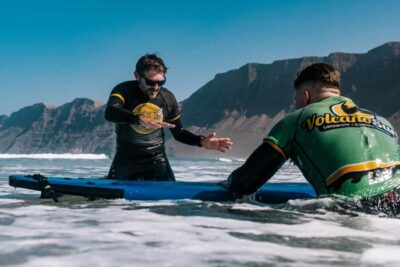
The Surftrip: A 2.5-hour morning surf session for beginners, intermediate surfers, and families.
Read our review →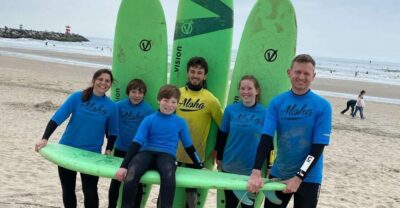
Scheveningen Beach: 1,5 hour Surf experience for families
Read our review →Browse the lists this lesson appears in